A new study by Michalis Charilaou explores how imperfections in iron change its magnetism as temperature rises.
New study co-authored by faculty member and graduate student shows persistent magnetic coupling across thick non-magnetic media
Wed, 09/23/2026 - 1:03pmTop Stories
New publication reveals how imperfections change the temperature dependence of iron magnetism
Graduate student shares his research experience in underwater acoustics
My Journey from River Research to Ocean Acoustics
A new study published in Physical Review B demonstrates that two magnetic materials can remain strongly coupled even when separated by a relatively thick, nonmagnetic copper layer. The research examines trilayers made from Ni₉₀Fe₁₀ and Fe₇₀Ga₃₀—materials that respond to magnetism by deforming in opposite ways.
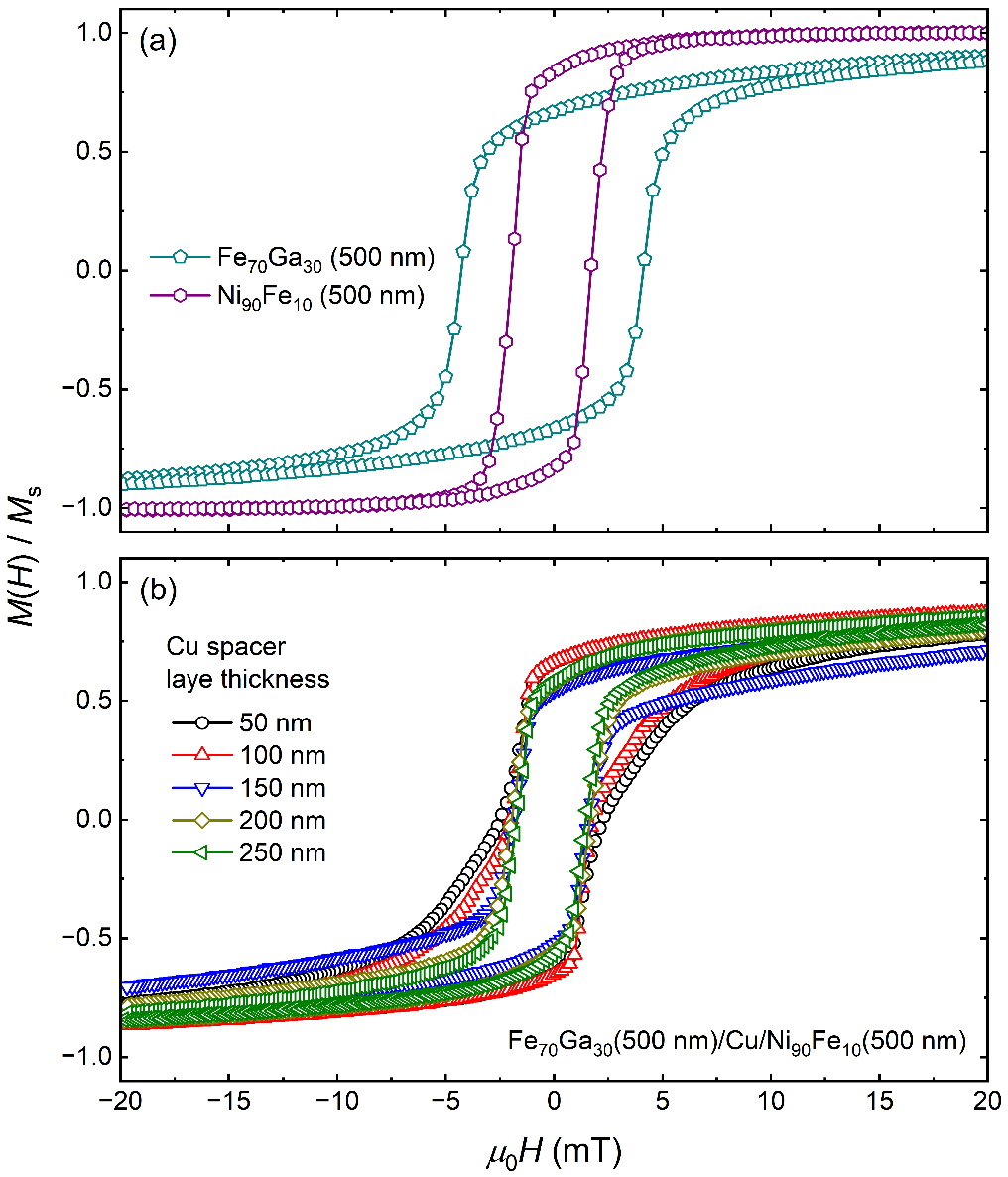
Using magnetic hysteresis measurements, ferromagnetic resonance experiments, and micromagnetic simulations, the researchers found that the two magnetic layers reverse their magnetization together and behave as a single magnetic system, as seen in the magnetization curves seen in the figure here. This coupling cannot be explained by direct magnetic exchange or ordinary dipolar interactions. Instead, the results point to magnetoelastic coupling, in which magnetic changes and mechanical strain are linked and transmitted through the layered structure.
The coupling is especially strong for copper spacer layers approximately 150–200 nanometers thick, while it begins to weaken for thicker spacers. These findings improve our understanding of how magnetic and mechanical properties can be combined in thin-film materials, with potential relevance to sensors, spintronic devices, and energy-efficient technologies.
The study was led by Dr. Michalis Charilaou of the UL Physics Department and collaborators at the Complutense University of Madrid, with co-author Giulianna Pacheco-Ethridge, a physics graduate student. The full article, “Magnetoelastic interlayer coupling in Ni₉₀Fe₁₀/Cu/Fe₇₀Ga₃₀ trilayers,” is published in Physical Review B 114, 084432 (2026).