Over the years, research in planetary science and space physics in the Department has been growing steadily.
New Paper by Physics Faculty Member Emphasizes Advantage of Machine Learning in Predicting Volcanic Eruptions
Sun, 10/25/2026 - 2:44pmBrian C. Dye, a PhD student in the Earth and Energy Science program, and his advisor Gabriele Morra have published that advances volcano monitoring towards continuous automation. They demonstrated that machine learning can detect small volcanic eruptions that previous automated monitoring systems missed.
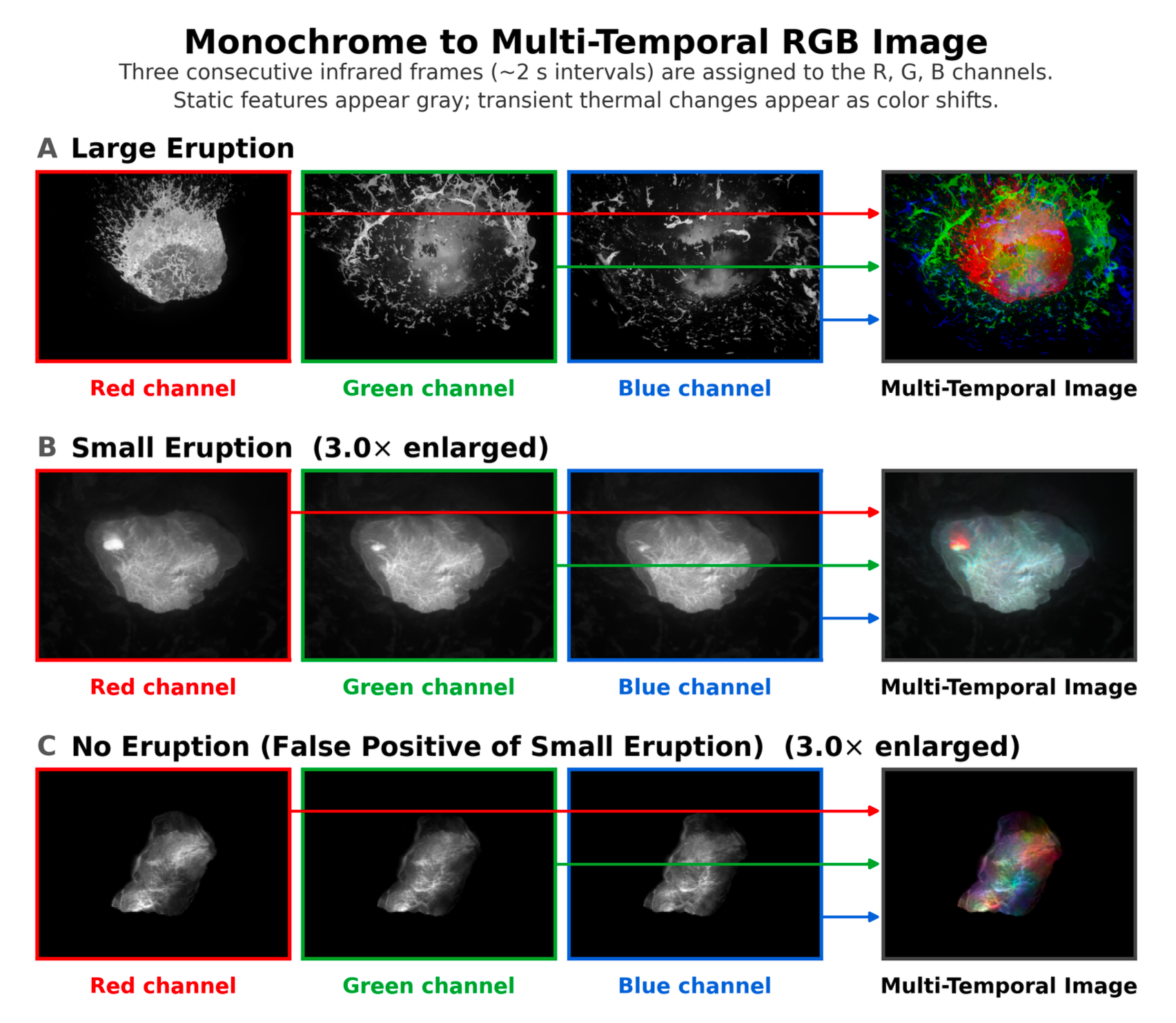
The team used IR images from the Ray lava lake at Mount Erebus in Antarctica to develop and test the techniques. They converted thermal camera footage into “multi-temporal” images, where three consecutive frames are stored as the red, green and blue channels of a single picture. A small eruption then appears as a colored spot, which lets a convolutional neural network learn what an eruption looks like as it develops. The network was trained on more than 54,000 images. The method was innovative through cleaning the training set with a technique called "Confident Learning", which finds and removes mislabeled examples. To test whether the model holds up over time, the researchers ran it on every image from December 2015, almost a year after the most recent training data:97% of the 420 small eruptions it flagged turned out to be real.
The paper, "Machine learning detection of small Strombolian eruptions in noisy multi-temporal infrared images: Toward continuous monitoring," was published in PNAS Nexus in 2026.