
Over the years, research in planetary science and space physics in the Department has been growing steadily.
Physics faculty member contributes to understanding the near absence of nitrogen from Earth's mantle
Mon, 10/13/2025 - 9:33am
Although about 80% of Earth’s atmosphere is nitrogen, the planet’s rocky mantle contains very little of it. Physics faculty member Dr. Gabriele Morra, coauthored a new publication about this mystery. In “A comparative study of nitrogen incorporation in silicate, metallic, and bulk Earth melts at high pressure” published in Earth and Planetary Science Letters (accessible here), they show, by using advanced computer simulations called First-Principles Molecular Dynamics, that, during Earth’s early history when the mantle existed as a molten “magma ocean,” nitrogen bonded strongly with iron. This suggests that much of the planet’s “missing nitrogen” may have sunk into the iron-rich core.
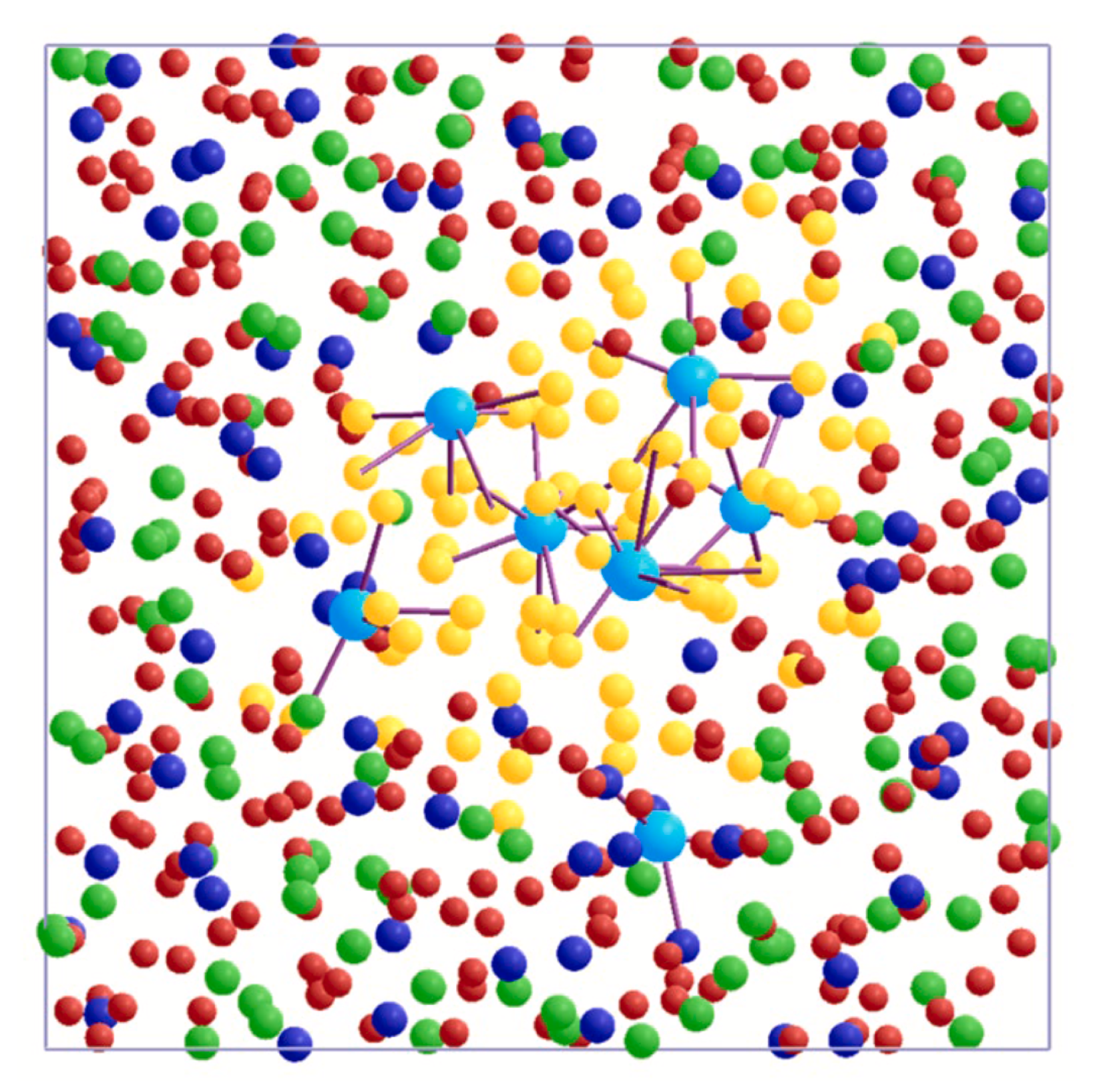
The figure shows the a snapshot of a simulated bulk Earth-like melt system where iron-atom (gold) cluster in the central region of the supercell. The bonds formed by N atoms (cyan large spheres) are mostly with Fe atoms and less with other atoms (Si blue spheres, Mg green spheres, and O red spheres). One N atom located in the lower side of the cluster is bonded with Si only.